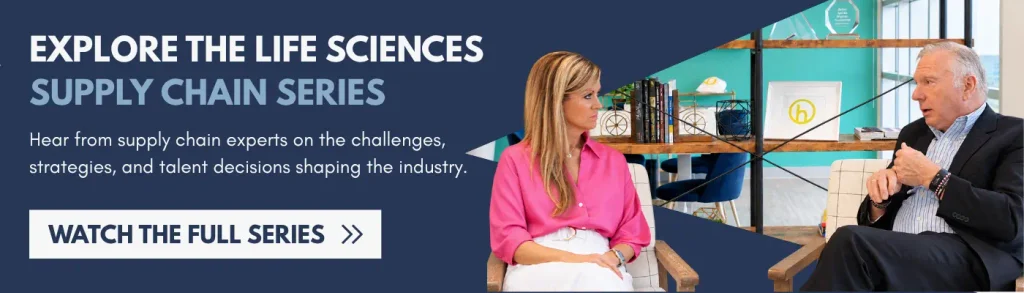
This is the first in a three-part series drawn from PrincetonOne’s video conversation with Scotty Kinn and Dave Malenfant on life sciences supply chain.
The Outsourcing Model That Works
Some companies run their entire manufacturing operation through contract manufacturers and never touch a production line themselves. According to Dave Malenfant, Founder and CEO of MDM Consulting, if done right, it’s one of the most effective models in the industry.
“They got great, long-term relationships,” he said. “They have quarterly business reviews. They share the data. They have the same dashboards. It’s like an extension of the internal team, just run by different people.“
The same logic applies to fulfillment and distribution, said Dave, where third-party logistics providers now do work that used to be handled in-house. Scotty Kinn, CSO of PrincetonOne, a Hueman brand, said outsourced hiring works the same way. “So, let’s say PrincetonOne builds the commercial team; we come in and sit right next to talent acquisition, right next to the operations leaders. We’re on the same systems. We’re sharing the same data. That’s the way it succeeds.”
The Version That Doesn’t Work Looks Almost Identical From the Outside
Dave didn’t stop at the success story. “We’ve had too many cases,” he continued, “where the industry has outsourced talent acquisition, and the company they outsourced it to doesn’t understand the dynamics. They haven’t spent the time to really sit down with the individuals who run the supply chain to understand it.“
That’s also why generic RPO can cost you your launch.
The result is predictable. “You get the wrong people. You don’t have the fit,” he said. “And it gives them a bad taste; it’s a trust that’s broken, and it’s going to take a very long time to rebuild that trust.“
Two outsourcing relationships. Same basic structure on paper: an outside partner running a function the company used to run itself. One becomes an extension of the team. The other becomes a source of bad hires and broken trust.
The difference is whether the partner learned about the business before trying to staff it.

How Operational Trust Gets Built
In Dave’s telling, what made the successful relationship work were specific, repeatable practices: shared dashboards, the same systems, quarterly business reviews, and enough time spent with the people running supply chain to understand how the function works before trying to hire for it. “The one thing that you and I had was trust,” he said. “You knew me as someone who doesn’t beat around the bush… and we’ve been able to build the trust well enough” that “if you have that trust, you can outsource anything.“
That’s a meaningfully different claim than “find a partner you click with.” It says trust in an outsourced relationship is built in the same way operational trust is built anywhere: transparency, shared data, and enough time in the details to understand the function before making decisions about it.
Why this matters more in life sciences than almost anywhere else
The supply chain in life sciences spans regulatory requirements, cold-chain logistics, combination-product complexity, and manufacturing scale-up, often all at once. A staffing partner who treats it like any other commercial hiring assignment will make exactly the mistake Dave described: filling seats without understanding what the seats need to do.
The bar for an outsourced partner in this space is whether they have done the work to understand the supply chain, commercial operations, and the regulatory environment well enough to know who fits before the first person ever gets placed.